
The Indian Institute of Foreign Trade (a deemed university) invites applications for its Executive Masters in International Business programme.

Quarterly earnings of corporates, trading activity of foreign investors and inflation data are the key factors that are expected to drive the momentum in the equity markets this week, analysts said.
The Indian Institute of Foreign Trade, Delhi, invites applications for its MBA programme in International Business.

"India's resilience (during the global financial crisis) has been recognised internationally. In my view, India may be beginning to see a multi-decade bull market," Jhunjhunwala said at a seminar organised by the Indian Institute of Foreign Trade in Mumbai.

High gold imports had contributed to high CAD which stood at 5.4 per cent in the second half of 2012-13 and was creating pressure on the rupee.
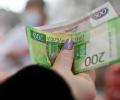
The government may soon give the green light to bilateral trade between Russia and India in their national currencies to avoid any trade disruptions, multiple people aware of the matter said. While the Department of Commerce has recommended the proposal, an announcement is likely to be made by the finance ministry after further deliberations between the Department of Economic Affairs and Department of Financial Services. "The finance ministry will take a call on how to peg the two currencies," a senior government official told Business Standard. In the past, the two nations have had rupee-rouble trade, and when such an arrangement is implemented again, it will bypass the sanctions imposed on Russia by the West.
President Droupadi Murmu on Saturday approved 139 Padma awards including seven Padma Vibhushans, 19 Padma Bhushans and 113 Padma Shris.

Bibek Debroy was one of the very few economists not bound by any single area of expertise and was simultaneously curious about economics and politics, myths and maths, chess and chemistry, and what not, remembers Laveesh Bhandari.
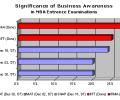
TCY experts offer Business Awareness/General Knowledge questions to supplement MBA examination preparation.
Conducted on November 25, 2007, the Indian Institute of Foreign Trade (IIFT) reverted to the one correct answer per question format. We take a look.

From the 30 Sensex firms, Larsen & Toubro, Reliance Industries, Axis Bank, Asian Paints, Tata Motors, Bajaj Finance, Maruti, Bajaj Finserv, Kotak Mahindra Bank, Titan, Adani Ports and HDFC Bank were the major laggards. JSW Steel emerged as the only gainer.

Sebi on Friday barred fugitive businessman Vijay Mallya from the securities markets and restrained him from associating with any listed firm for three years in the matter of routing of funds to the Indian securities market using overseas bank accounts with UBS AG. The Indian government has been attempting to extradite Mallya from the United Kingdom to face fraud charges related to his now-defunct company Kingfisher Airlines. Mallya has been living in the United Kingdom since March 2016.
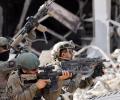
'Israel would make Iran and its proxies pay. They, along with Qatar, fund terror all over the world.'

With response tepid so far from domestic investors, these funds might soon approach FIPB for approvals.

The primary and immediate impact of a depreciating rupee is on the importers who will have to shell out more for the same quantity and price. However, it is a boon for the exporters as they receive more rupees in exchange for dollars. The rupee depreciation has wiped away some of the gains that would have accrued to India from international oil and fuel prices dropping to pre-Ukraine war levels.
From fainting during a Class 12 exam to failing the NDA thrice, Arun Pandit would easily have succumbed to his suicidal urges, had it not been for a friend whose motivational SMS changed his life forever.

A Rs 2 health insurance scheme for rural India and a project on empowering cooperative banks through effective application of information technology -- ideas that looked at tackling such problems received the thumbs-up from the jury of the Business Standard B-school Award 2012 held here on Tuesday.

Reader Anshul Goel sent us this picture from New Delhi.

Benchmark equity indices Sensex and Nifty ended lower on Monday after hitting their all-time high levels in early trade amid selling in blue-chip IT stocks and HDFC Bank. After breaching the 77,000-mark during the early trade, the 30-share BSE Sensex came under selling pressure at the fag-end of the session and ended 203.28 points or 0.27 per cent lower at 76,490.08. During the day, the benchmark jumped 385.68 points or 0.50 per cent to hit a new record of 77,079.04.

'When compared to many of America's treaty allies in Asia, Modi 3.0 is on a much stronger footing.'
London-based author Ruchita Misra talks to Sahim Salim about her first book The (In)eligible Bachelors a funny tale of a young single MBA grad and her search for the perfect husband.
London-based author Ruchita Misra talks to Sahim Salim about her first book The (In)eligible Bachelors a funny tale of a young single MBA grad and her search for the perfect husband.

Gautam Adani, India's second-richest man, and seven others including his nephew Sagar have been charged with paying bribes to unidentified officials of state governments in Andhra Pradesh and Odisha to buy expensive solar power, potentially earning more than $2 billion profit over 20 years.

Global trends, macroeconomic data announcements and the start of the earnings season would be the major drivers for the equity markets in a holiday-shortened week, analysts said. Equity markets will remain closed on Thursday for Eid-Ul-Fitr. Trading activity of foreign investors, rupee-dollar trends and crude oil prices would also guide trends in markets.
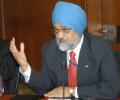
India should learn to live with high energy prices for rapid economic growth, said Planning Commission Deputy Chairman Montek Singh Ahluwalia after two of the state-owned oil companies hiked petrol rates this week.

In this round, the market has won. But it is still for Gautam Adani to decide whether he has lost or not, argues Shekhar Gupta.
Indian Institute of Foreign Trade, New Delhi, invites applications for MBA (International Business) degree programme conducted at New Delhi and Kolkata Centres.

Nilkancha Badhiye who is currently pursuing her MBA in International Business from the Indian Institute of Foreign Trade (IIFT), Delhi tells us how she cracked the entrance examination while pursuing her final year of graduation.
Global factors and FII activity will dictate trends in domestic equity markets this week while assembly poll results of Maharashtra and Jharkhand may impact stocks on Monday, say analysts. Stock markets witnessed a spirited recovery on Friday with benchmark Sensex and Nifty notching the best single-day gains in more than five months and offering relief after weeks of correction.
The government must review its policy to allow foreign direct investment up to 24 per cent in the small and medium scale enterprises, and ensuring better credit facility and technology financing to make them globally competitive.
The Indian Institute of Foreign Trade(IIFT) is planning a campus in South India, after Delhi and Kolkata, as the student representation from the region is quite low.

Anticipating US action on tariffs, India seems to have made the first move by revamping its tariff structure by reducing the slabs to eight rates, points out Mukesh Butani.
Nearing a b-school exam? Don't know where to start? Here's a list of what you should do and avoid while preparing for a b-school exam. Read on.

The directions follow a report by the Indian Cyber Crime Coordination Centre, which has seen a new pattern of transnational cyber-enabled financial fraud and investment scam, impersonating as stockbrokers and company executives.

RBI interest rate decision, macroeconomic data and global trends would guide markets' movement this week, analysts said. Besides, trading activity of foreign investors and the last batch of Q1 earnings announcements would also guide trends in equities. HSBC PMI (Purchasing Managers' Index) for the services sector is scheduled to be announced on Monday.

British Indian think tank 1928 Institute organised a special roundtable entitled 'India and the Indo-Pacific' bringing together the High Commissioners of India, Bangladesh, Australia, Canada, Nepal, among others, ahead of the reception in the River Room of the House of Lords on Monday evening.
The Indian Institute of Foreign Trade is conducting the entrance exam for admission in their MBA course for 2007-2008.
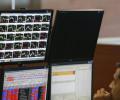
The RBI is considering permitting FII and commercial banks to trade on Indian commodity exchanges.
